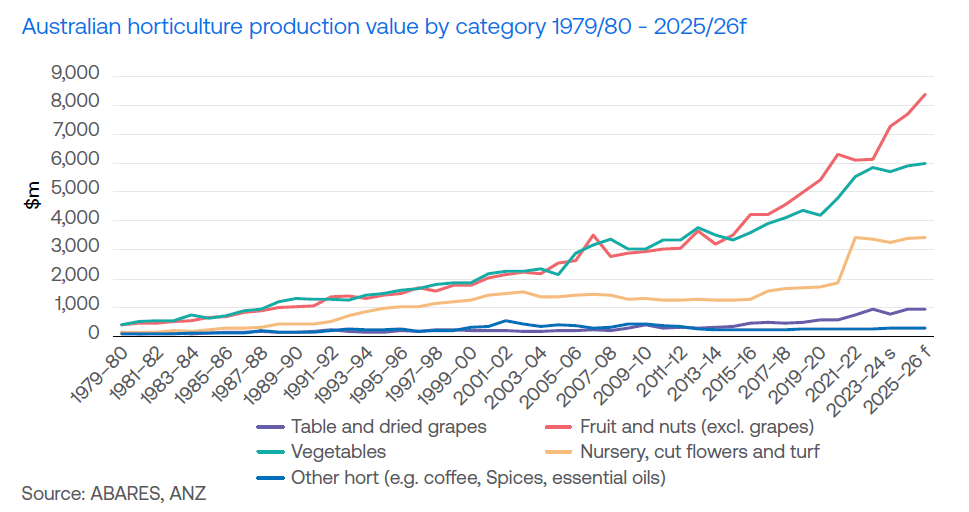
When looked at as a whole, the Australian horticultural sector should be travelling well. ABARES recorded the value of horticultural production at $A18.2 billion in 2024–25, rising to a forecast $19 billion in 2025–26. The continued growth in the gross value of production is due to both higher domestic and export sales. Exports are projected to climb to $A4.4 billion in 2026.
As shown by the following chart, fruit and nuts remain the largest sector by value, accounting for approximately 40 per cent of production, followed by vegetables and nursery sales.
Domestic sales growth is partly attributable to population growth and food inflation, with the ABS reporting that the cost of fruit and vegetables rose by 4.4 per cent in 2025, higher than the reported CPI increase of 3.8 per cent.
Export growth has continued to increase significantly, driven by strong sales of nuts to India and China and fruit (particularly table grapes and citrus) to China, Japan and south-east Asian countries.
The following chart shows sectoral growth over the past 37 years.
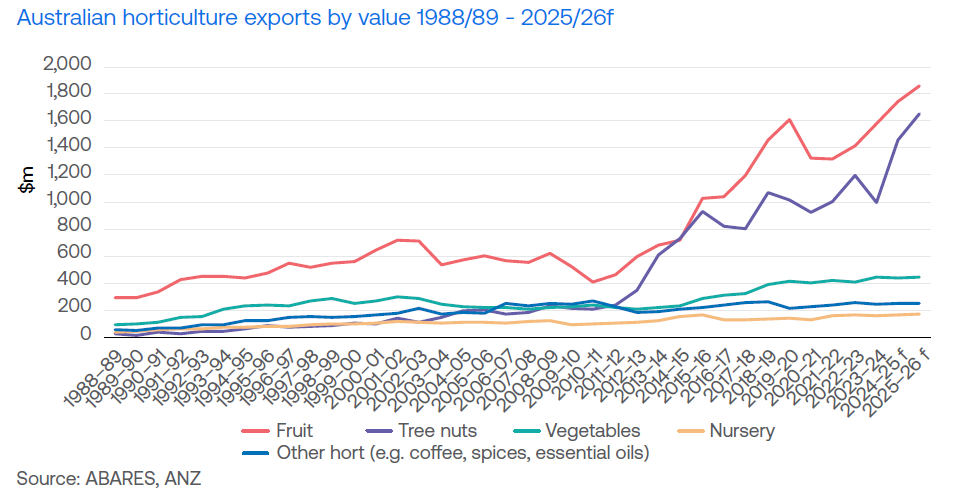
Australia exports very little fruit and nuts to the USA, and so the introduction of tariffs has not caused any significant impact. In fact, the presence of USA tariffs has probably assisted our export growth with many countries choosing to buy Australian products in retaliation to the tariffs imposed by the USA.
Strong export sales to India have been assisted by the introduction of more favourable free trade agreements.
Against this mostly good news story, it is perhaps surprising that there continues to be weak demand for horticultural properties. However, the reality is that there were few significant horticultural sales during 2025 and agents are reporting that buyers are thin on the ground.
The reasons for this pervasive cautiousness appear to be higher growing costs, reduced margins and concerns around competition from other southern hemisphere producers, including Chile, Peru and South Africa.
Over the past 12 to 18 months, the continued refrain we hear from both small and large producers is that higher production costs, particularly labour, have eroded their margins. The reality is that costs have increased more than income, and this has reduced both free cash and the ability to service debt.
There are several large-scale horticultural properties currently listed for sale, covering the citrus, almond, pome fruit and table grape industries, plus many small to mid-size table grape vineyards. Many of these properties have been for sale for over 12 months. Buyers clearly feel they can afford to take their time and also to haggle on price and settlement terms.
Any properties of a secondary nature are considered likely to transact at relatively low prices. The recent sale of the Thurla almond orchard, located in north-western Victoria to the west of Red Cliffs, is a good example. This property was widely advertised as being sold under mortgagee in possession circumstances and included some older trees of inferior standard, together with some complicated irrigation water supply arrangements. While the property also included a large area of young trees and is considered to have good potential, the eventual sale price reflected a relatively low rate per hectare.
This exemplifies a trend we have seen over many property cycles. When confidence is high, properties sell quickly, and the spread in rates per hectare between first-class and secondary properties narrows. When confidence is low, the spread between the sale prices of high-standard properties and inferior properties widens. This is what we are seeing now.
We are aware of several distressed assets currently being marketed across several horticultural sectors. There is a risk that the inevitably reduced sale prices these properties will achieve will have a flow-on effect to values more broadly.
Meanwhile, the Australian dollar has appreciated by 10 per cent in the past six months, which will negatively impact export returns, but also reduce the cost of imported fertiliser, machinery etc.
Some other trends we are currently seeing include:
Capital being diverted to redevelopment of existing, less lucrative plantings and varieties, rather than expansion. This has always been an issue with the stone fruit industry, however is now extended to table grapes, pome fruit and to a lesser extent citrus.
We are also mindful that around 33 per cent of the existing almond orchards in Australia are approaching 25 years of age. The industry expanded significantly between 2001 and 2006, driven by managed investment schemes. Many of the country’s larger growers own areas with these older trees, and so are currently planning redevelopment. This will require significant capital due to both cost and lost income. On the positive side, there will be an opportunity to establish self-fertile varieties that are not reliant on bees for pollination and allow more efficient management.
The cost of leasing irrigation water across the Murray, Goulburn and Murrumbidgee river systems has increased substantially in the past nine months, from rates below $100 per megalitre to over $500 per megalitre. There are very few producers in the southern connected Murray Darling basin who will be immune to this higher cost. If dry conditions extend into mid to late 2026, there is a risk of reduced allocations in 2026/27 and ongoing elevated costs.
An increasing volume of mortgagee in possession sales. A number of enterprises in the wine grape and table grape sectors are under financial strain, with creditors now running out of patience. Often the creditor is not the main lender, with some heavily geared producers also reliant on secondary lenders.
Increased demand for rural lifestyle properties surrounding larger regional towns has allowed smaller scale horticultural producers to exit at favourable prices. This trend has always existed, however the significant rise in the value of residential properties in the past three to four years has had a profound impact in areas such as Orange in New South Wales and the northern rivers of New South Wales.
A number of large-scale olive orchards being developed in southern Australia, capitalising on the current global shortage of olive oil, the proven ability to grow olives at scale and the ability of olives to tolerate some secondary soil types.
There have been few significant sales in recent times. Notable sales during late 2025 include Thurla farms (a large almond orchard referred to above), 888 Produce (a medium-sized, well-managed table grape vineyard located near Mildura, which sold for good levels) and two table grape vineyards at Emerald, Queensland, one of which sold for strong levels and one which sold quite cheaply, reflecting some older development. The Emerald properties were purchased by southern producers wanting to extend their harvest window.