When most people think of Australia’s construction industry, their minds turn to the residential housing market. News cycles are dominated by stories of property booms, interest rate hikes, and the subsequent busts that see homebuilders collapse. It’s a narrative of volatility, centred almost exclusively on the homes we live in.
However, a deeper analysis of the industry, based on the latest IBISWorld report, reveals a far more complex and resilient picture. The common perception, it turns out, only tells half the story. Beneath the surface of the housing market’s fortunes lies a fundamental structural shift where the industry’s fragmented base of small operators is increasingly vulnerable, while its overall growth has become almost entirely dependent on government-led mega-projects.
A housing slump can’t stop an infrastructure boom
The Australian construction industry is currently a tale of two very different sectors. On one side, residential building has been on a rollercoaster ride. The market peaked in 2021-22, fueled by record-low interest rates and government stimulus. But as the RBA raised the official cash rate during 2022-23 to quell inflation, activity plummeted, and many homebuilders have succumbed to financial pressures.
In stark contrast, the non-residential sector is thriving. This is not a cyclical boom but a deliberate policy response, as governments brought forward major projects to stabilise the economy post-COVID. This surge in transport and energy infrastructure has become the true engine of the industry’s growth, more than compensating for the housing construction downturn.
To put into sharp focus:
- Robust transport and energy infrastructure construction has assembled revenue growth, outweighing a residential building construction downturn.
- This reveals a two-speed economy within the construction division. While residential builders face intense headwinds, the industry’s overall stability and growth are now strategically underwritten by massive public investment.
An army of independents, not a league of giants
Given its staggering $641.1 billion in revenue and workforce of over 1 million people, one might assume the construction industry is dominated by a handful of corporate giants. The reality is the exact opposite. The report identifies the industry as having “low” market share concentration.
The evidence is compelling. The four largest companies combined account for less than 4% of the total market share. The remaining 96.4% is made up of “Other Companies”, a vast collection of smaller competitors. The most surprising detail, however, lies in the composition of these businesses. According to the report, “Over half the enterprises in the Construction division have no paid employees, indicating the large presence of non-employing sole traders.”
This composition explains the industry’s perceived fragility; with a shallow capital base and minimal labour overhead, these businesses can enter the market easily during booms but are also the first to exit during downturns. Australia’s construction landscape is not a league of giants but a highly fragmented army of independent contractors. But while the industry is defined by its small players, its future is being shaped by the largest forces imaginable: government policy and the global energy transition.
The future is built on public projects and green energy
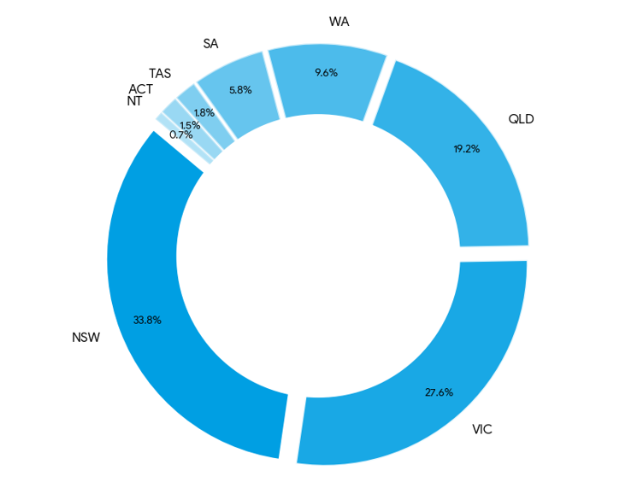
Looking ahead, the industry’s growth trajectory is firmly tied to two key areas: large-scale public works and the transition to renewable energy. Landmark road and rail projects like Sydney’s WestConnex, Brisbane’s Cross River Rail, and Melbourne’s massive $34.0 billion Level Crossing Removal Project are pumping billions into the economy.
Simultaneously, a massive wave of investment is flowing into renewable energy, including major developments like the 1,026-megawatt (MW) MacIntyre Wind Farm in Queensland. On top of this, the upcoming 2032 Brisbane Olympic Games will provide another significant pipeline of non-residential building work. This trend signals that the future of Australian construction is not being shaped by suburban sprawl, but by strategic, nation-building decisions on public infrastructure and the global energy transition.
Profit squeeze
Despite impressive top-line revenue growth, the financial reality for most construction businesses is precarious. This financial stress is most acutely felt by the massive contingent of smaller operators who form the industry’s backbone.
The core reason is a severe profit squeeze. Many of these smaller builders operate on fixed-price contracts, leaving them dangerously exposed to supply chain disruptions and soaring input costs. With ‘Purchases’ including building materials, subcontractors and consumables already constituting 55.0% of total revenue, there is little room to absorb shocks. This creates an inverted risk profile: the industry’s headline growth is driven by large-scale public projects, but the financial pain is borne by the 96.4% of smaller firms, particularly those in the struggling residential sector.
This dynamic reveals a critical vulnerability in Australia’s construction supply chain, where the financial health of the vast majority of operators is precariously balanced against macroeconomic forces beyond their control.
A new blueprint for Australia
The Australian construction industry is far more complex than the housing headlines suggest. It’s an industry being fundamentally reshaped by a new blueprint, one where a public infrastructure boom papers over a private housing construction slump, and where a $641.1 billion industry rests on the shoulders of sole traders operating on razor-thin margins.
This structural shift towards a future defined by massive public works and green energy presents both immense opportunity and significant risk. The central challenge is clear: as Australia builds its future on state-funded projects, hundreds of thousands of small, independent operators that form the industry’s backbone are facing the challenge of adapting to a new world where they are more vulnerable than ever.